Last updated: September 2026 · Written by Packwise – packaging specialists in design, functionality, and future-proof solutions
In short: PET bottles are lightweight, affordable, and durable, while glass packaging is perceived as premium and can be recycled indefinitely without loss of quality. The choice between PET and glass depends on your product's weight, mode of transport, price point, and the end-of-life destination of the packaging. There is no single right answer, only the right answer for your product.
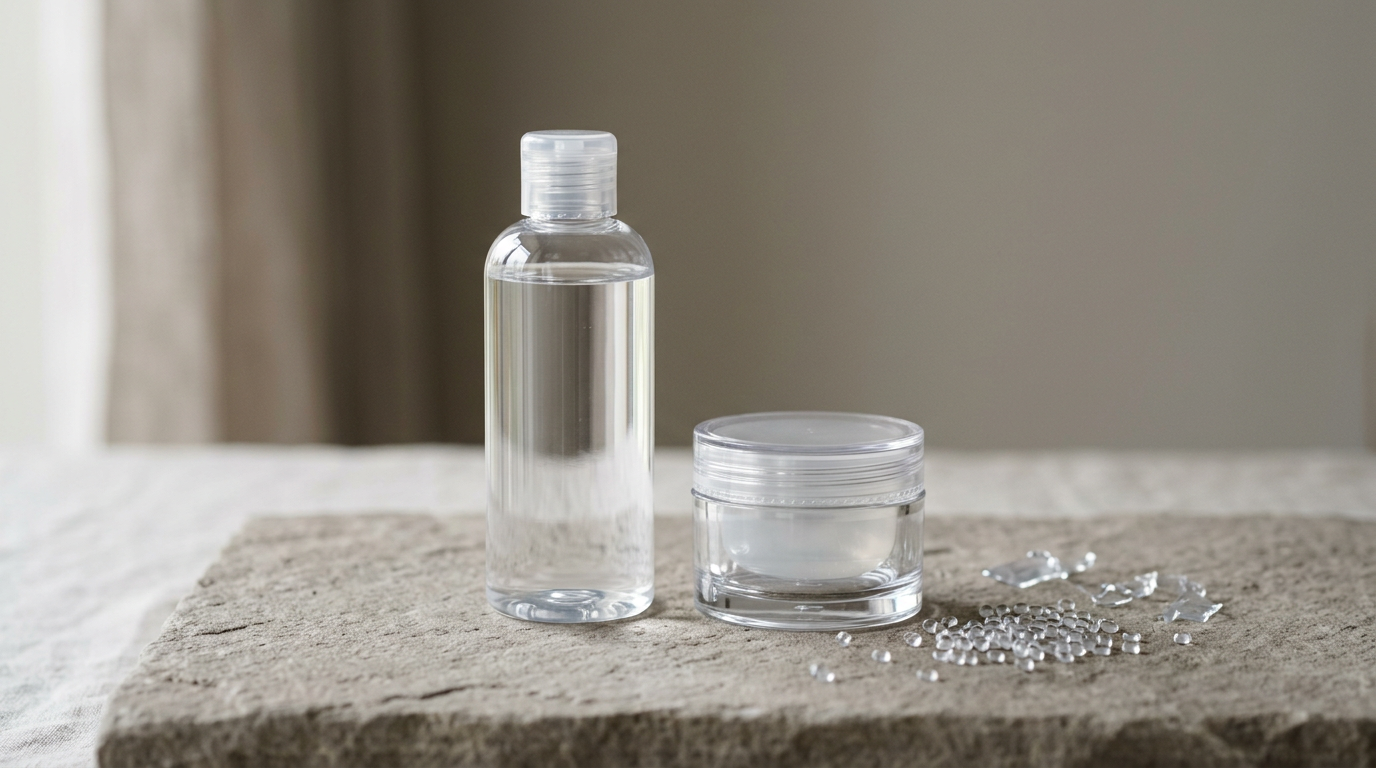
PET (polyethylene terephthalate) is a type of plastic used for bottles because it is lightweight, strong, and transparent. It is widely used for beverages, cosmetics, skincare, and cleaning products.
Glass is one of the oldest packaging materials and consists primarily of melted sand. It is chemically inert, 100% recyclable, and is often associated with quality and exclusivity, particularly in cosmetics, spirits, and premium food products.
The choice of material has a greater impact on the carbon footprint than many expect, and weight is often the deciding factor. A comparison mentioned by the industry media EmballageFOKUS shows that the carbon footprint for vodka sold in glass bottles is 27% higher than for the same product in a recyclable PET bottle. This is primarily because glass weighs more and therefore requires more energy to transport, regardless of how recyclable the material is in theory.
This does not mean that glass is always the worse choice. It means that recyclability alone is not the whole story, and that you should look at the entire life cycle, including weight and transport, when assessing what is actually most sustainable for your specific product.
Is PET or glass more sustainable?
It depends on how you measure it. Glass can be recycled infinitely without loss of quality, but it is heavier and requires more energy to transport. PET weighs less and therefore often has a lower carbon footprint per unit transported, but it is more sensitive to designs that make recycling difficult.
Is glass packaging more expensive than PET?
Generally yes, both in purchase price and in shipping costs due to the weight. However, the price difference can be offset if glass makes it possible to sell the product at a higher price due to the perceived quality.
Can PET be recycled as many times as glass?
No. In practice, glass can be recycled again and again without losing quality, while PET degrades slightly with each recycling cycle. On the other hand, PET is much easier to collect efficiently in systems like the Danish deposit scheme.
When does packaging best signal premium?
Glass typically wins on perceived quality thanks to its weight, clarity, and finish. If the product competes on exclusivity, such as perfume or spirits, glass is often the strongest choice, even if it costs more to produce and transport.
There is no single correct answer. The right choice depends on your product, your pricing strategy, your market, and how the packaging will be collected afterwards. At Packwise, we help you weigh function, design, and sustainability so that you land on the solution that actually makes sense for your business.
Packwise are packaging specialists with deep experience in cosmetic and pharma packaging. We advise brands on the choice of packaging solutions from the concept phase to production.
You are always welcome to contact us. Whether it is sparring, a concrete inquiry or ideas for cooperation and development, we are happy to engage in dialogue and look at the possibilities together.





.avif)
.avif)
.avif)